CHALAN TERRIERS 

Breed Show Standards


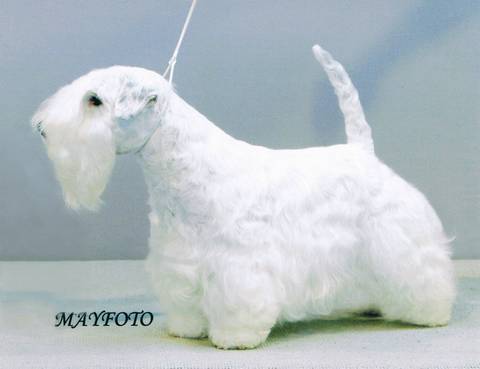
The Sealyham Terrier

Average Lifespan

The Sealyham Terrier can live to 15 years. Owners must realise they are taking this lovely breed on for its lifetime.
 
Breed Personality/Characteristics/Temperament
 
 
Those fortunate people who have had a good Sealyham Terrier seldom want one of another breed in its place. A good Sealyham is meant to be good in character, health and looks. They are individuals and completely satisfying as companions in and out of doors and they make very good guards. 
 
They become devoted to their family of owners, they never forget a friend or a foe. They are most affectionate and return the love they get fully and joyfully.
 
They are a lovely size and can curl up in an amazingly small space. They are naturally fond of children, love to play ball and quickly learn tricks, love to fetch, retrieve and carry.
 
***************************************************************************
 
The Australian Sealyham Terrier Show Standard

GENERAL APPEARANCE - Free moving, active, balanced and of great substance in small compass.  General outline oblong, not square. 

CHARACTERISTICS - Sturdy, game and workmanlike. 

TEMPERAMENT - Alert and fearless but of friendly disposition. 

HEAD AND SKULL - Skull slightly domed and wide between ears.  Cheek bones not prominent.  Punishing square jaw, powerful and long.  Nose black. 

EYES - Dark, well set, round, of medium size.  Dark, pigmented eyerims preferred but unpigmented tolerated. 

EARS - Medium sized, slightly rounded at tip and carried at side of cheek. 

MOUTH - Teeth level and strong with canines fitting well into each other and long for size of dog.  Jaws strong with regular scissor bite, i.e. upper teeth closely overlapping the lower teeth and set square to the jaws. 

NECK - Fairly long, thick and muscular on well laid shoulders. 

FOREQUARTERS - Forelegs short, strong and as straight as possible consistent with chest being well let down.  Point of shoulder in line with point of elbow which should be close to side of chest. 

BODY - Medium in length, level and flexible with ribs well sprung.  Chest broad and deep, well let down between forelegs. 

HINDQUARTERS - Notably powerful for size of dog.  Thighs deep and muscular with well bent stifle.  Hocks strong, well bent and parallel to each other. 

FEET - Round and catlike with thick pads.  Feet pointing directly forward. 

TAIL - Set in line with back and carried erect.  Quarters should protrude beyond set of tail.  (Docking of the tail is illegal in Australia)

GAIT/MOVEMENT - Brisk and vigorous with plenty of drive. 

COAT - Long, hard and wiry topcoat with weather-resistant undercoat. 

COLOUR - All white or white with lemon, brown, blue or badger pied markings on head and ears.  Much black and heavy ticking undesirable. 

SIZE
Ideal weight Dogs approx. 9 kg (20 lbs) 
 Bitches approx. 8.2 kg (18 lbs) 
Height:  should not exceed 31 cms (12 ins) at shoulder. 
General conformation, overall balance, type and substance are main criteria. 

FAULTS - Any departure from the foregoing points should be considered a fault and the seriousness with which the fault should be regarded should be in exact proportion to its degree. 

NOTE - Male animals should have two apparently normal testicles fully descended into the scrotum.

                              The Cesky Terrier Standard


GENERAL APPEARANCE : Short legged, long haired, well made and well muscled Terrier with smallish drop ears, of a rectangular format.

IDEAL MEASURES :                              Male              Female

Height at withers                                29 cm                27 cm

Length of skull                                   21 cm                 20 cm

Width of skull                                    10 cm                   9 cm

Girth of thorax (behind elbows)             45 cm                 44 cm

Length of body                                  43 cm                  40cm  

BEHAVIOUR / TEMPERAMENT : Balanced, non-aggressive, pleasant and cheerful companion,   easy to   train;

 somewhat reserved   towards strangers; of calm and kind disposition.

HEADShaped like a long, blunt, not too broad wedge, the plane of the

forehead forming a distinctive breaking with the bridge of the nose.

Skull : Not too broad between the ears and tapering moderately towards the supraorbital ridges.

Occipital protuberance easy to palpate; cheek bones moderately prominent.   Frontal furrow only slightly marked.

Stop : Not accentuated but apparent.

FACIAL REGION :

Nose : Dark and well developed. It should be black on Terriers with a

grey-blue coat and liver-coloured on light-coffee brown Terriers.

Nasal bridge : Straight.

Jaws/teeth : Strong jaws.   Scissors or level bite; complete dentition

(the absence of the 2 M3 in the lower jaw not being penalized). Teeth

strong, regularly aligned and set square to the jaw.

Lips : Relatively thick, fitting neatly.

Cheeks : Cheek bones not too prominent.

Eyes : Of medium size, slightly deep set, with a friendly expression; well covered by the overhanging eyebrows.  

Brown or dark brown in grey-blue coated dogs, light   brown in light-coffee-brown dogs.

Eyelids black in grey-blue dogs, liver-colour in light-coffee-brown dogs.

Ears : Of medium size, dropping in such a way as to well cover the

orifice. Set on rather high and falling flat along the cheeks.

Shaped like a triangle, with the shorter side of the triangle at the fold of the ear.

NECK : Medium long, quite strong, carried on a slant. The skin at the throat is somewhat loose but without forming a dewlap.

BODY : Oblong.Upper line : Not straight because loins and rump are always moderately arched.


Withers : Not very pronounced; neck set on rather high.

Back : Strong, of medium length.

Loins : Relatively long, muscular, broad and slightly rounded.

Croup : Strongly developed, muscular; pelvis moderately slanting. Hip bones often slightly higher than the withers.

Chest : More cylindrical than deep; ribs well sprung.

Belly : Ample and slightly tucked up. Flanks well filled.

 
TAIL : The ideal length is 18-20 cm; relatively strong and low set.

At rest hanging downward or with a slight bend at the tip; when alert

the tail is carried sabre shape horizontally or higher.


LIMBS

FOREQUARTERS : The forelegs should be straight, well boned and parallel.

Shoulders : Muscular.

Elbows : Somewhat loose, yet neither turned in nor out.

Forefeet : Large; well arched toes and strong nails.   Pads well developed and thick.

HINDQUARTERS : Hindlegs strong, parallel, well angulated and muscular.

Lower thigh : Short.

Hock joint : Set relatively high, strongly developed.

Hindfeet : Smaller than the forefeet.

GAIT / MOVEMENT : Free, enduring, vigorous, with drive.   Gallop rather slow but lasting. 

The forelegs extend in a straight forward line.

SKIN : Firm, thick, without wrinkles or dewlap, pigmented.


COAT

TEXTURE : Hair long, fine but firm, slightly wavy with a silky gloss; not too much overdone.

The Czech Terrier is groomed by scissors (clipping). At the forepart of the head the hair is not to be clipped thus forming brows and beard. 

On the lower parts of the legs, under the chest and belly the hair should not be clipped either.  

In show condition the hair at the upper side of the neck, on the shoulders and on the back should not be longer than 1 - 1,5 cm;

It should be shorter on the sides of the body and on the tail and quite short on the ears, cheeks, at the lower side of the neck, on elbows, thighs and round the vent.  

The transition between clipped and unclipped areas should be pleasing for the eye and never abrupt.

COLOUR : The Czech Terrier has 2 varieties of coat colour :

- grey-blue (puppies are born black)

- light-coffee-brown (puppies born chocolate brown)

In both colour varieties yellow, grey or white markings are permitted on the head (beard, cheeks), neck, chest, belly, the limbs and round the vent. 

Sometimes there is also a white collar or a white tip of the tail. The basic colour, however, must always be predominant.

HEIGHT AND WEIGHT :

Height at withers between 25 - 32 cm.   Ideal size for a dog = 29 cm,

for a bitch = 27 cm.

The weight must not be less than 6 kg and more than 10 kg.

FAULTS : Any departure from the foregoing points should be considered a fault and the seriousness with which the fault should be regarded

should be in exact proportion to its degree and its effect upon the health and welfare of the dog.

·     Weak construction.

·     Temporary loss of nasal pigmentation (snow nose).

Weak, short or snipey foreface, with weakly developed teeth.


Contact Details
Jane Hyman
Pearcedale, VIC, Australia
Phone : 03 59785157
Email : sealys@bigpond.com

Dogz Online - Dogs, Breeders, Puppies